
Are you new to HEMA and looking to buy your first sword? What should you consider, and how do you choose the right one?
The first thing to understand is that a sword cannot be defined by a single parameter, such as blade length, weight, flexibility, or point of balance (POB).
A sword is a complete system where all parameters work together. Changing one parameter can significantly influence how the sword behaves.
For example, some fencers try to maximize their reach by choosing extremely long blades. While this provides extra reach, a disproportionate blade-to-handle ratio can result in a sword that handles more like a hoe than a well-balanced weapon.
Maximizing one parameter doesn’t necessarily make a better sword.
At Haft, our philosophy is to balance all these parameters so they complement each other. The result is a sword with comfortable handling, fast cuts, smooth transitions, and precise blade control.
A well-designed sword should work with the fencer, not against them.
- No single number defines a good feder: weight, point of balance, flex, length and handle work as one system.
- Where the weight sits matters as much as how much the sword weighs.
- Compare flex only together with its measurement method and deflection. We publish pommel flex at 25 cm.
- Check your club’s and your tournaments’ rules before you buy.
- Haft 128: compact and precise. Haft 134: reach and versatility. Compare them side by side.
Point of Balance (POB)
The point of balance significantly influences how a sword behaves.
Generally, the further forward the POB, the more blade presence and cutting authority the sword tends to have. However, moving it too far forward can make the sword harder to control and contribute to unnecessarily heavy impacts during sparring.
At Haft, we’ve found that a POB of around 6 to 6.5 cm works particularly well with our designs.
Combined with the right weight distribution, it provides fast cuts, quick changes of direction, smooth transitions between guards, and enough blade presence for effective parries and blade contact.
However, POB alone doesn’t tell the whole story. Two swords with identical weight and balance points can still handle very differently because their mass is distributed differently along the blade.
This affects their moment of inertia, which determines how much effort is needed to start, stop, or redirect a movement.
Weight
You might assume that a lighter sword is always faster and easier to handle, while a heavier sword is slower and more cumbersome.
In reality, it’s not that simple.
A relatively heavy sword can feel surprisingly light and responsive when its proportions and weight distribution are properly balanced.
On the other hand, even a lightweight sword can feel awkward and slow when these parameters don’t work together.
That’s why we don’t focus on achieving the lowest possible weight at any cost. Our goal is to combine low weight with the right distribution of mass.
It’s not just about how much a sword weighs, but where that weight is located.
Blade Flexibility and Safety
Flexibility is one of the most misunderstood parameters in HEMA swords.
Many fencers assume that a lower flex value, such as 10 to 12 kg, means a safer but more floppy blade, while a higher value means a stiffer sword that’s stronger in the bind.
But flexibility and blade stability are not the same thing.
How floppy or stable a blade feels depends heavily on its geometry, especially its grinding profile and how the thickness changes along its length.
With the right geometry, it’s possible to create a blade that bends relatively easily during thrusts while remaining stable and responsive during cuts and blade contact.
At Haft, we carefully tune the blade geometry to achieve this combination. And if a blade does take a set after a hard thrust, that’s normal and easy to fix.
Why Flex in Kilograms Doesn’t Tell the Whole Story
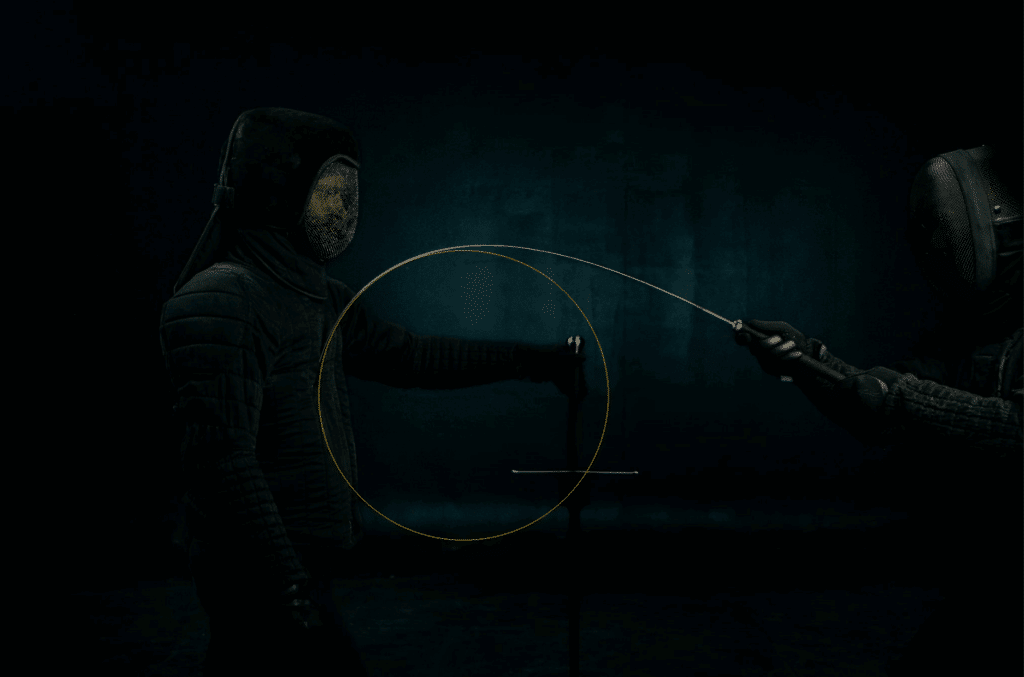
A flex value tells us how much force is required to bend a blade under specific test conditions. However, there’s another important parameter that many people overlook: deflection, the distance through which the blade bends.
Imagine two swords that both reach a flex reading of 13 kg.
One reaches that force after bending 15 cm, while the other reaches it after 25 cm.
Although the numbers are identical, the blades behave differently. Their force-deflection curves are not the same, and neither is their response during a thrust.
A blade with a greater usable bending distance can provide more room to manage the energy of an impact. However, actual safety also depends on the force throughout the bend, the tip design, and the fencer’s control.
That’s why comparing flex values without knowing the measurement method and deflection distance can be misleading. Tournament rulesets measure it differently too: compare, for example, the FEBUS equipment rules with your own event’s.
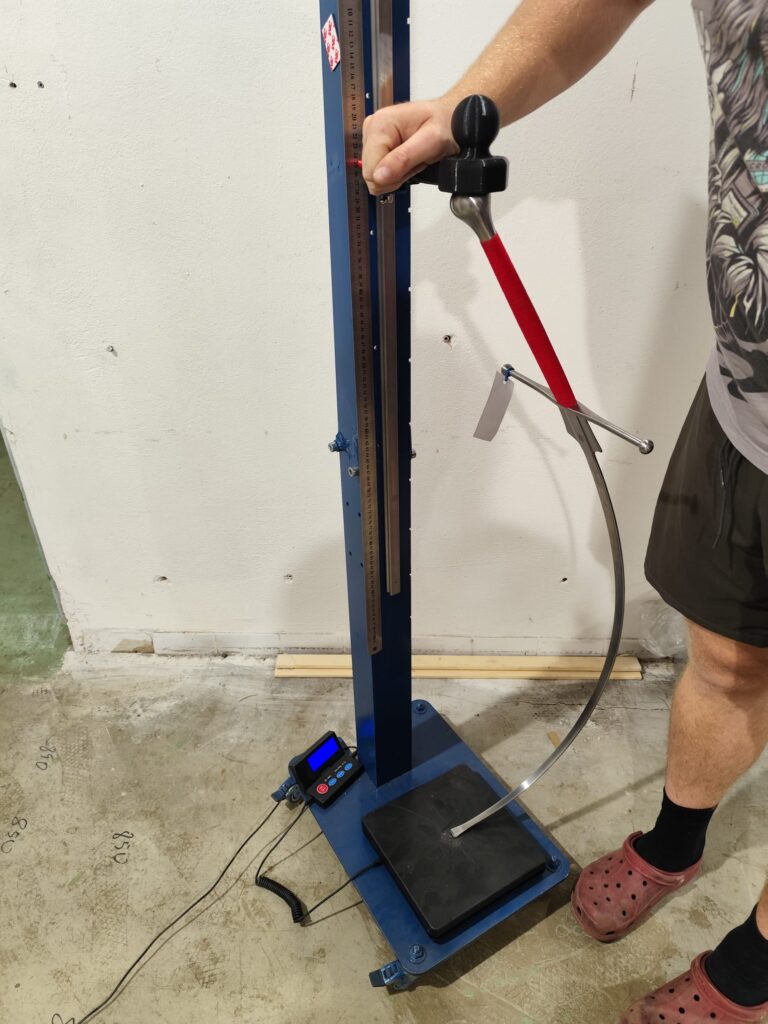
At Haft, we publish flex measurements under defined conditions, including pommel flex at 25 cm of deflection, so fencers know what the numbers actually mean.
For a detailed explanation, read our article: Sword Flex: How We Define and Measure It at Haft Arms
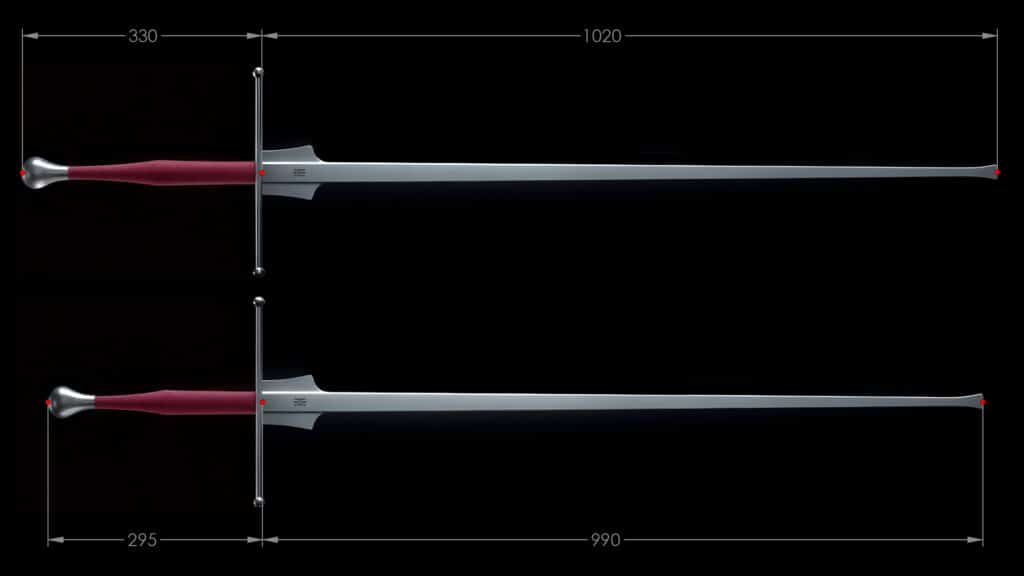
Length: Shorter or Longer Sword?
Length is another important factor when choosing your first HEMA sword.
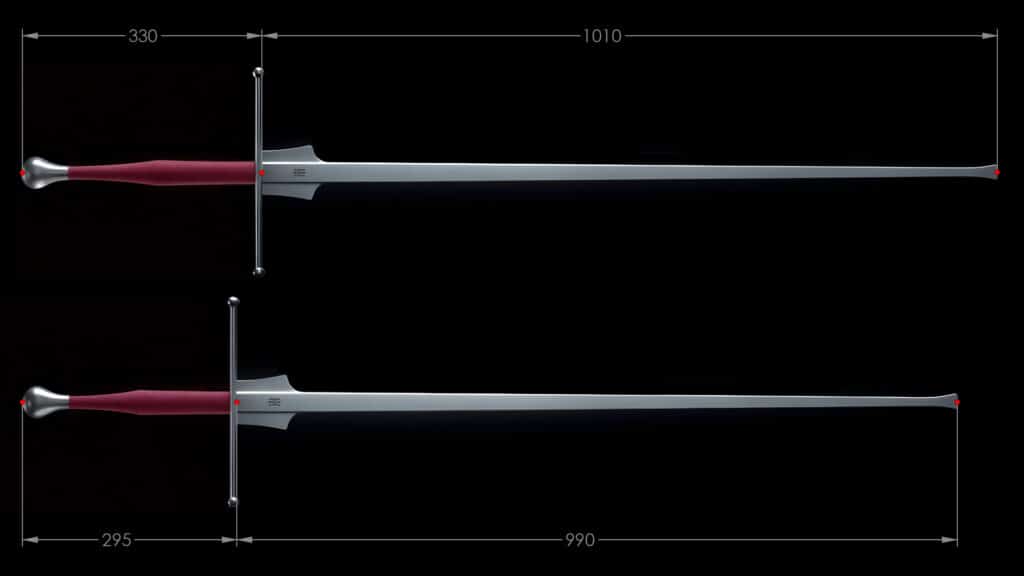
A longer sword provides greater reach, while a shorter sword can offer more compact handling. However, the proportions between blade and handle are just as important as the overall length.
At Haft, we offer two carefully balanced models.
| Specification | HAFT 128 (compact) | HAFT 134 (reach) |
|---|---|---|
| Total length | 128.5 cm (50.6″) | 134 cm (52.8″) |
| Blade length | 99 cm (39″) | 101 cm (39.8″) |
| Hilt length | 29.5 cm (11.6″) | 33 cm (13″) |
| Point of balance | 6.5 cm (2.56″) | 6 cm (2.36″) |
| Weight | approx. 1,425 g (3.14 lbs) | approx. 1,470 g (3.24 lbs) |
| Weight tolerance | ±15 g | ±15 g |
| Pommel flex | 13 kg ±0.5 kg at 25 cm | 13 kg ±0.5 kg at 25 cm |
Haft 128: Compact and Precise
The Haft 128 features historically inspired proportions and a shorter handle. It offers precise point control and distinctive handling characteristics, making it particularly interesting for fencers who enjoy winding, binding, and technical blade work.
Its compact dimensions offer excellent maneuverability, although this comes with slightly reduced reach, and the shorter handle may feel restrictive to some fencers wearing bulky protective gloves.
Haft 134: Reach and Versatility
The Haft 134 provides slightly more reach and a longer handle, offering additional leverage and room for hand positioning.
It’s designed as a versatile tournament feder, combining reach, speed, and control.
Which should you choose?
Neither is universally better. The choice depends on your fencing style, personal preferences, and protective equipment. Your height alone doesn’t determine which sword is right for you.
We’ve covered the differences in detail here: Haft Feder 128 vs. 134: Which Length Is Right for You?
Handle Shape and Comfort
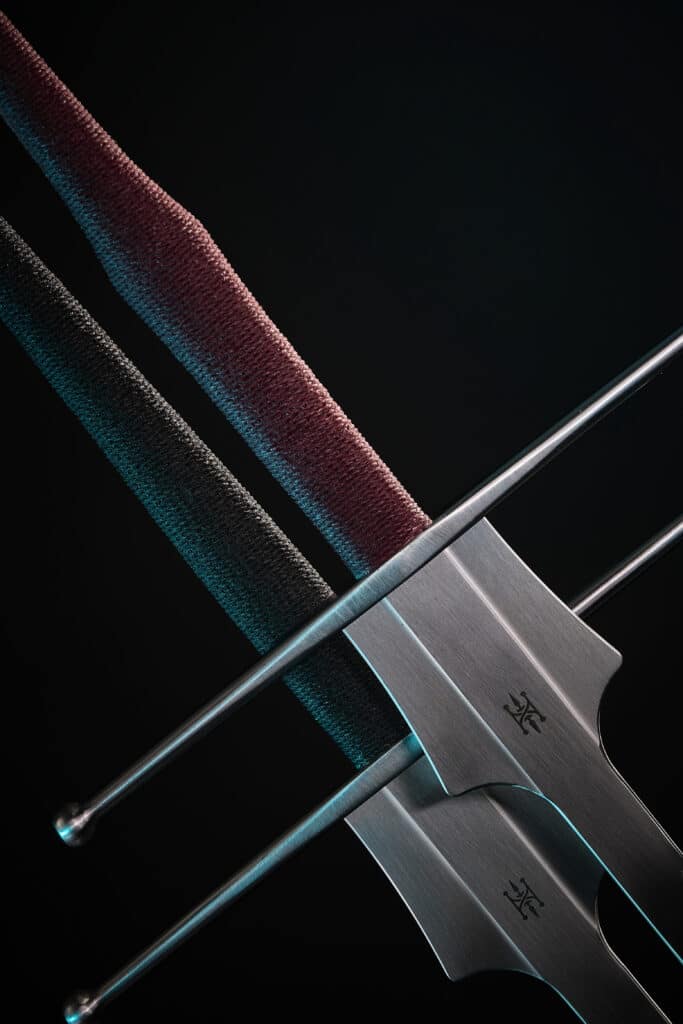
Another detail worth considering is the shape of the handle.
At Haft, we offer both standard and waisted handles on the 128 and the 134.
The standard handle provides a familiar, versatile grip suitable for almost any fencing style.
The waisted handle features an elegant, historically inspired shape that gives the sword a distinctive appearance while providing a comfortable, natural grip and greater freedom in certain hand positions and complex guards, such as Pflug, as described in the historical fencing sources.
Both options are designed for comfortable fencing. The best choice comes down to personal preference, especially how the handle feels with your fencing gloves.
Precision and Consistency: Why They Matter
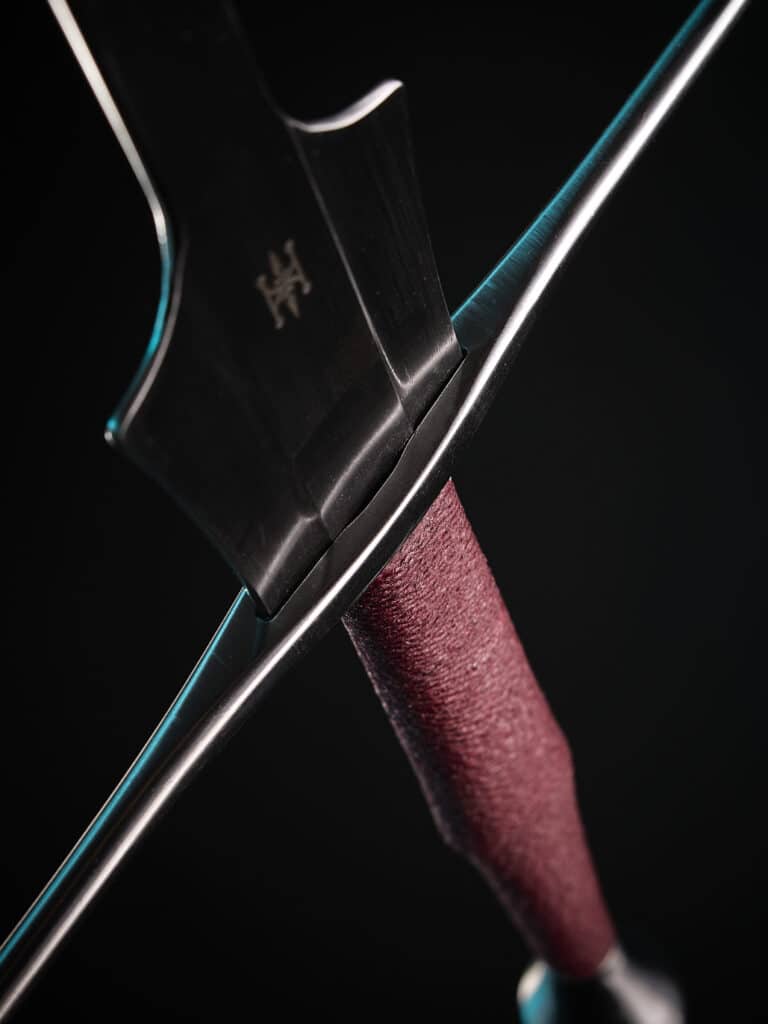
Even a perfectly designed sword is only as good as its manufacturing consistency.
Small differences in blade geometry can have a surprisingly large impact on performance.
For example, a change of just 0.1 mm in blade thickness can noticeably affect flexibility. In our measurements, such a difference can account for approximately 1 kg of flex force.
This is why precision matters.
At Haft, we use controlled manufacturing processes, dedicated fixtures, and quality checks to keep important parameters within defined tolerances.
Our published specifications include a weight tolerance of ±15 g and a pommel-flex tolerance of ±0.5 kg for both models.
Our goal is simple: when two fencers buy the same Haft model, they should receive swords that behave as consistently as possible.
This approach is also reflected in feedback from the HEMA community. Fencers have highlighted our swords’ responsive handling, point control, blade presence, and build quality. We’ve also received positive comments about the consistency of weight and flex during tournament equipment checks.
For us, precision isn’t just about making a sword look good. It’s about making its performance predictable, reliable, and repeatable.
Why We Don’t Offer Endless Customization
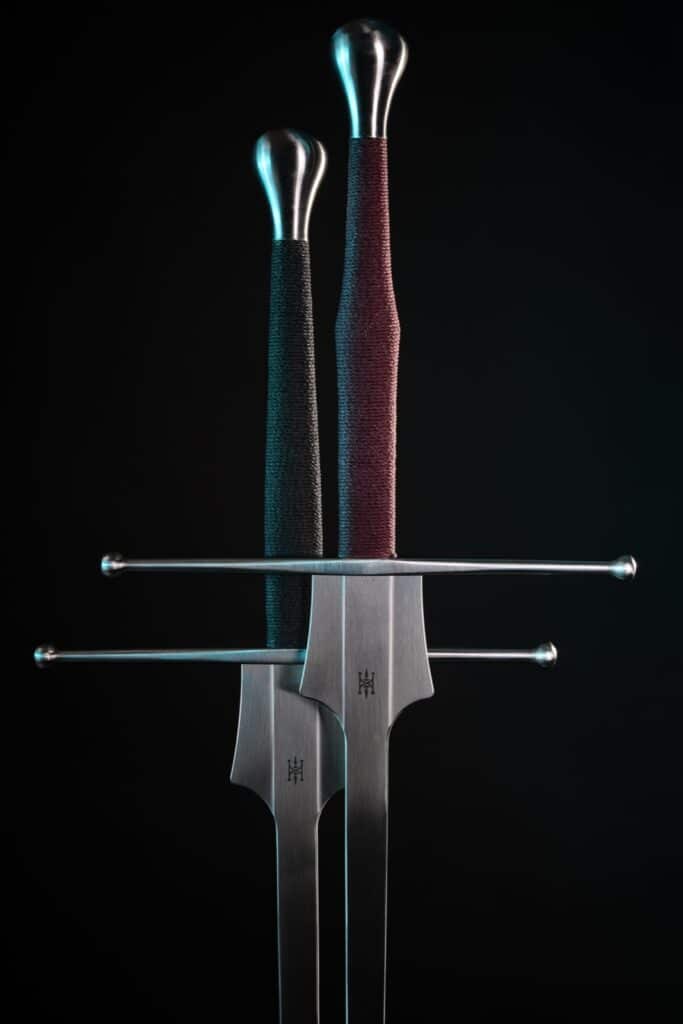
Many fencers want to build their own sword by individually selecting the blade length, handle length, pommel, and crossguard.
While customization offers plenty of possibilities, not every combination works well together.
The final weight, balance, and handling characteristics can be difficult to predict. Sometimes you only discover how the sword behaves once it’s fully assembled.
That’s why we’ve done the balancing work for you.
Both the Haft 128 and 134 have been developed as complete designs, with carefully tuned proportions, blade geometry, and weight distribution.
For example, the Haft 134 was developed with tournament fencing in mind. Its 101 cm blade was one of the important design constraints, particularly for competitions with stricter blade-length requirements.
Instead of simply attaching that blade to an arbitrary handle, we adjusted the other components to achieve the handling we wanted.
The result is a relatively lightweight sword with excellent balance, responsive handling, and solid blade presence.
By focusing on carefully developed models rather than unlimited combinations, we can also maintain consistent manufacturing quality and shorter delivery times.
So, Which HEMA Sword Should You Buy?
If you’re choosing your first feder, here are a few practical recommendations:
- Check your club and tournament rules. Blade length, flex, weight, and tip requirements can vary between events. HEMA Ratings lists tournaments, and most publish their rulesets.
- Choose a length that suits your fencing style. Don’t automatically assume that longer is better.
- Don’t judge a sword by a single number. Weight, POB, and flex only make sense when considered together.
- Consider your protective gloves. A handle that feels comfortable with bare hands may feel very different with bulky HEMA gloves.
- Try the sword if possible. Ask your instructor or experienced club members for advice. Buying for the whole club? See our club and group orders.
And remember, you don’t necessarily need to buy a beginner sword that you’ll want to replace after a few months.
A properly designed, well-balanced feder can serve you from your first training sessions to serious tournament fencing.
Final Thoughts
At Haft, we believe a great sword isn’t defined by impressive numbers on a specification sheet. It’s defined by how it performs in your hands.
That’s why we don’t simply assemble components. We carefully tune every part of the sword to work together, from blade geometry and weight distribution to grip comfort and manufacturing consistency.
Our goal is to create swords that feel natural, respond precisely, and perform reliably, whether you’re just starting your HEMA journey or competing at a high level.
Because the best sword is the one that lets you focus on your fencing, not on fighting against your equipment.
Frequently Asked Questions
Don’t judge a sword by a single number. Weight, point of balance, flex, length and handle shape only make sense together. Check your club and tournament rules, think about your protective gloves, and try the sword if you can.
No. A relatively heavy sword can feel light and responsive when its weight is well distributed, and a light sword can feel slow when it isn’t. It’s not just how much a sword weighs, but where that weight is located.
Not on its own. A flex value only makes sense with its measurement method and the deflection distance. Safety also depends on blade geometry, the tip and the fencer’s control. Haft publishes pommel flex at 25 cm of deflection.
The Haft 128 is compact and precise, with historically inspired proportions and excellent point control. The Haft 134 offers more reach and a longer handle for leverage. Your height alone doesn’t decide it: see Haft Feder 128 vs. 134.
The standard handle is a familiar, versatile grip for almost any style. The waisted handle gives more freedom in some hand positions and guards, such as Pflug. Choose by how it feels with your fencing gloves.
Not necessarily. A properly designed, well-balanced feder can serve you from your first training sessions to serious tournament fencing, so you don’t have to replace it after a few months.
Read more: HAFT 128 vs. 134 · How we measure sword flex · My sword is bent. Should I be worried? · The design of our feder · Why we started Haft · Club and group orders
Haft Arms news
New feders, restocks and offers, now and then. No spam.